Sep 7, 2011

Pictures of the week from Ganesha with the Indian team to hurricane Irene.

Pictures of the week 29th Aug - 4th Sept.


India Team With Ganesha.


 For Post Details:

Fireworks are seen in the sky over St. Basil Cathedral, left, and Spasskaya tower,right, at the International Military Music Festival Spasskaya Tower at the Red Square in Moscow, Russia, Wednesday, Aug. 31, 2011. Festival was opening on Wednesday in Moscow for five days. (AP Photo/Mikhail Metzel).

Overflowing water from a river floods a residential area in Nachikatsuura, central Japan, Sunday, Sept. 4, 2011. The center of the season's 12th typhoon was moving slowly north across the Sea of Japan, the Japan Meteorological Agency said. (AP Photo/Kyodo News)

A rebel fighter chants "Allahu Akbar" as he stands near a Russian-made scud missile that was found in Junine

A serviceman of the Belarussian Interior Ministry's special unit controls a ball as he takes part in a relay race during a show to commemorate the annual Day of Special Forces celebration in Minsk September 4, 2011. REUTERS/Vladimir Nikolsky (BELARUS - Tags: MILITARY SOCIETY)

An idol of elephant headed god Ganesh depicts the Hindu god being lifted by members of the Indian cricket team as idols are displayed for sale ahead of Ganesh Chaturti festival in Ahmadabad, India, Tuesday, Aug. 30, 2011. The idols will be immersed into oceans and rivers at the end of the festival that celebrates the birth of the Hindu god. (AP Photo/Ajit Solanki)

An aerial view shows houses submerged in flood water caused by the strong tropical storm Talas in Kiho town, Mie prefecture, in western Japan

Afghan refugee boys play on a homemade swing as they celebrate the second day of Eid al-Fitr festival which marks the end of the Muslim fasting month of Ramadan, on the outskirts of Islamabad, Pakistan, Thursday, Sept. 1, 2011. Eid, one of the most important holidays in the Muslim world, is marked with prayers, family reunions and other festivities. (AP Photo/Muhammed Muheisen)

reland's Deirdre Ryan walks across the track during the Women's High Jump qualification round at the World Athletics Championships in Daegu, South Korea, Thursday, Sept. 1, 2011. (AP Photo/Kevin Frayer)

Iranian women perform their Eid al-Fitr prayer, at the Imam Sq. in the city of Isfahan some 234 mile (390 kilometers) south of the capital Tehran, Iran, Wednesday Aug. 31, 2011. Eid al-Fitr is the Islamic holiday that comes at the end of the fasting month of Ramadan. (AP Photo/Vahid Salemi)

Two cheetah cubs peek through wild flowers at the Smithsonian Conservation Biology Institute in Front Royal, Va., Wednesday, Aug. 31, 2011. The five cubs in the litter are 13-weeks-old. When they mature the cubs will become part of a national breeding program for the endangered species. (AP Photo/Jacquelyn Martin)

Rafael Nadal, of Spain, celebrates his 6-3, 7-6 (1), 7-5 victory over Andrey Golubev, of Kazakhstan, during the first round of the U.S. Open tennis tournament in New York, Tuesday, Aug. 30, 2011. (AP Photo/Elise Amendola)

A little Turkana girl walks towards an Oxfam distribution center to receive food in central Turkana district, Kenya.Tuesday, Aug. 30, 2011. . The U.N. says tens of thousands of people already have died in Somalia, Kenya, Ethiopia and Djibouti due to famine and has warned that the famine hasn't peaked. More than 12 million people in the region need food aid, according to the U.N. (AP Photo/Tobin Jones) .

A young James' flamingo is followed by a full grown flamingo in its enclosure at the zoo in Berlin, Germany, Tuesday, Aug. 30, 2011. The young bird is one of three flamingos that were born between July and August 2011 at the Berlin zoo. (AP Photo/Michael Sohn)

A rebel fighter observes landscape at a rebel checkpoint some 80 kilometers from rebel-held Misrata, and some 167 kilometers from pro-Gadhafi-held Sirte, LIbya, early Tuesday, Aug. 30, 2011. (AP Photo/Sergey Ponomarev)

Officials survey the damage to route 12 on Hatteras Island, NC., Sunday, Aug. 28, 2011. Hurricane Irene swept through the area Saturday cutting the roadway in five locations. Irene caused more than 4.5 million homes and businesses along the East Coast to reportedly lose power over the weekend, and at least 11 deaths were blamed on the storm. (AP Photo/Steve Helber).

Sources from www.Yahoo.in.

Sep 2, 2011

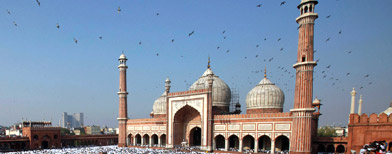
Jama-Masjid -The days of Ramzan


The days of Ramzan


Over the last fortnight, I have found myself waiting impatiently for the clock to strike 6 pm; just around the time of evening prayers, before the fast is broken.
In the days of Ramzan, the air at 6 pm is thick with celebratory aroma; the road across the mosque is lined with stalls, cooking up a storm, and it draws a crowd like moths to a flame.
The people it draws are wide and varied. I look around me as I wait for my first taste of the evening's pleasures. I see a girl with a dark, khol-rimmed eyes and a nose ring mount her bicycle, with a bag of steaming sheekh hung across the handle bars. Groups of boys, curly-haired and goateed, tear into legs of tandoori kebab. A couple of college girls with colourful jholas march determinedly from one booth to the next, paper plate in hand, steadily munching on assorted goodies. The local celebrity chef moves from stall to stall on a food walk with his friends, sampling the wares and taking pictures. And couples, united by their love of food, share a plate on the pavement, while beggars, daddies, and doggies squeeze by. Just about everyone appears to have turned up at this cook-out.
And everyone's either got a plate, waiting for one, or simply eating out of someone else's. The assortment of food on this stretch of road means that you will certainly find something that suits your palate. We begin with mutton samosas - crisp, juicy and absolutely delectable, you just can't stop at one. My partner-in-gluttony and I share three before moving on to the next indulgence. We move in no particular order really, merely following our noses. My personal favourite, string hoppers (iddi-appams) and sheekh kebabs appear to be a ruaway hit today, and the hoppers are vanishing fast. I decide it's time for drastic measures. Grabbing the token from partner-in-gluttony I squeeze my way to the front of the grill, armed with my sole advantage - I am the only girl at this stall.
"Bhaiya, chaar semiya please?" (Punctuate with sweet smile and imploring eyes). He looks up suspiciously (oh no, this isn't going to work! And the charcoal-and-sheekh smell in my hair will all be for nothing!). But the foodie in me refuses be deterred by the narrowed eyes of a harrowed cook, so I continue to smile determinedly, with my hand outstretched. And before long, six string hoppers are heaped into my plate!
Sting hoppers, made from steamed rice flour, a maze of spirals, is the perfect foil to tender, warm, melt-in-the-mouth sheekh. In under a minute, the plate is cleaned out, and looks at us for a refill.
It is time for deep-fried divinity - the kheema roti. These stuffed rotis are so hot that the oil still sizzles atop its deep-brown crust; my mouth waters. In a single bite, I taste the goodness of freshly kneaded roti and the succulence of kheema; the crisp outer layers hide deep, soft, scrumptious insides. Heat and spice add to the excitement of every bite. Eyes glazed over in concentration, with no time for talking, the stuffed roti holds every sense captive.
Wordlessly, we obey the post-kheema craving to find ourselves outside Mama's Chai stall. A charming, white-bearded man greets us with familiarity, "Madaaam! Good to see you! Where have you been all these days?" He saw us only yesterday, but we play along; all in good humour. He pours us two cups of tea. Although, I must point out that it seems grave injustice to call this brew merely tea. The milk for this concoction, he tells us, is set to boil from eight in the morning. And it stays on the stove until the fast is broken after evening prayers. In this elaborate process of milk reduction, the spices are thrown in sometime before sunset, while the black tea is prepared separately. At the appointed hour, when the foodies show up, what they see is thick, creamy liquid topped with a dash of black brew. It is served in shot-glass sized portions, and those four sips are infinitely more refreshing than anything I have tasted.
At this point, food coma sets in, and we are too happy and full-bellied to attempt conversation. Saluting the kindly tea-stall gentleman, and fully intending to return the following evening, we make our way home.
I can't think about eating right now, but at the back of my mind, a quiet excitement builds. It won't be long before D-day, when our generous Muslim friends throw open their homes, and invite us to join their celebration. Until then, I will dream of fragrant grains of biryani, homemade with love and care, the culmination of the season's rejoicing. Happy Eid!
Jama-Masjid-The days of Ramzan


Over the last fortnight, I have found myself waiting impatiently for the clock to strike 6 pm; just around the time of evening prayers, before the fast is broken.
In the days of Ramzan, the air at 6 pm is thick with celebratory aroma; the road across the mosque is lined with stalls, cooking up a storm, and it draws a crowd like moths to a flame.
The people it draws are wide and varied. I look around me as I wait for my first taste of the evening's pleasures. I see a girl with a dark, khol-rimmed eyes and a nose ring mount her bicycle, with a bag of steaming sheekh hung across the handle bars. Groups of boys, curly-haired and goateed, tear into legs of tandoori kebab. A couple of college girls with colourful jholas march determinedly from one booth to the next, paper plate in hand, steadily munching on assorted goodies. The local celebrity chef moves from stall to stall on a food walk with his friends, sampling the wares and taking pictures. And couples, united by their love of food, share a plate on the pavement, while beggars, daddies, and doggies squeeze by. Just about everyone appears to have turned up at this cook-out.
And everyone's either got a plate, waiting for one, or simply eating out of someone else's. The assortment of food on this stretch of road means that you will certainly find something that suits your palate. We begin with mutton samosas - crisp, juicy and absolutely delectable, you just can't stop at one. My partner-in-gluttony and I share three before moving on to the next indulgence. We move in no particular order really, merely following our noses. My personal favourite, string hoppers (iddi-appams) and sheekh kebabs appear to be a ruaway hit today, and the hoppers are vanishing fast. I decide it's time for drastic measures. Grabbing the token from partner-in-gluttony I squeeze my way to the front of the grill, armed with my sole advantage - I am the only girl at this stall.
"Bhaiya, chaar semiya please?" (Punctuate with sweet smile and imploring eyes). He looks up suspiciously (oh no, this isn't going to work! And the charcoal-and-sheekh smell in my hair will all be for nothing!). But the foodie in me refuses be deterred by the narrowed eyes of a harrowed cook, so I continue to smile determinedly, with my hand outstretched. And before long, six string hoppers are heaped into my plate!
Sting hoppers, made from steamed rice flour, a maze of spirals, is the perfect foil to tender, warm, melt-in-the-mouth sheekh. In under a minute, the plate is cleaned out, and looks at us for a refill.
It is time for deep-fried divinity - the kheema roti. These stuffed rotis are so hot that the oil still sizzles atop its deep-brown crust; my mouth waters. In a single bite, I taste the goodness of freshly kneaded roti and the succulence of kheema; the crisp outer layers hide deep, soft, scrumptious insides. Heat and spice add to the excitement of every bite. Eyes glazed over in concentration, with no time for talking, the stuffed roti holds every sense captive.
jama-masjid-The days of Ramzan 

Aug 31, 2011

London celebrates Notting Hill Carnival

London celebrates Notting Hill Carnival


Ragis Glace, a member of the Extreme Carnival mas band, poses for a picture on August 24, 2011 in London, England. The Notting Hill Carnival is due to take place on August 28 and 29.

Costumed revellers perform in the Notting Hill Carnival in London, Monday, Aug. 30, 2010. Held each August Bank Holiday since 1966, the Notting Hill Carnival is the largest festival celebration of its kind in Europe. 

Revellers dance as they parade through the street during the children day of Notting Hill Carnival in London, Sunday, Aug. 28, 2011
.

Performers take part in the Notting Hill Carnival on August 28, 2011 in London, England. The annual carnival, which is the largest of it's kind in Europe and is expected to attract around 1 million revellers, has taken place every August Bank Holiday since 1966.

Performers take part in the Notting Hill Carnival on August 28, 2011 in London, England. The annual carnival, which is the largest of it's kind in Europe and is expected to attract around 1 million revellers, has taken place every August Bank Holiday since 1966.

Performers take part in the Notting Hill Carnival on August 28, 2011 in London, England. The annual carnival, which is the largest of it's kind in Europe and is expected to attract around 1 million revellers, has taken place every August Bank Holiday since 1966.

LONDON, ENGLAND - AUGUST 24:  A member of the Genesis Carnival mas band gestures during a photocall on August 24, 2011 in London, England. The Notting Hill Carnival is due to take place on August 28 and 29.

Members of the Genesis Carnival mas band poses during a photocall on August 24, 2011 in London, England. The Notting Hill Carnival is due to take place on August 28 and 29.


Sources from: Yahoo.in

Aug 17, 2011

Ancient 'sea monster' was pregnant

Ancient 'sea monster' was pregnant

Plesiosaur dinosaur fossil solves breeding puzzle


plesiosaur
plesiosaur
plesiosaur
Add caption
Add caption.
Add caption

An adult Polycotylus latippinus, one of the giant, carnivorous, four-flippered reptiles known as plesiosaurs that lived during the Mesozoic Era, is shown giving birth in this publicity illustration released to Reuters August 12, 2011. A paper published in the journal Science Friday states that a fossil of the creature on display in Los Angeles with bones in its abdomen are evidence of a fetus, and that this species produced offspring through live birth. REUTERS/Stephanie Abramowicz/Natural History Museum of Los Angeles/Handout.

A photograph of the fossil of a 78-million-year-old, 15.4-foot-long adult Polycotylus latippinus, one of the giant, carnivorous, four-flippered reptiles known as plesiosaurs that lived during the Mesozoic Era is shown in this publicity photo released to Reuters August 12, 2011. A paper published in the journal Science Friday states that the bones in the creatures abdomen are evidence of a fetus and that this species produced offspring through live birth. REUTERS/Natural History Museum of Los Angeles/Handout.

This undated handout photo provided by the journal Science shows the detail of a Polycotylus latippinus' embryo. The giant reptile was pregnant when she died more than 70 million years ago, according to a new analysis of the remains that offers the first proof that Plesiosaur gave birth to live young rather than laying eggs. AP Foto/Science.

A photograph of the fossil of a 78-million-year-old, 15.4-foot-long adult Polycotylus latippinus, one of the giant, carnivorous, four-flippered reptiles known as plesiosaurs that lived during the Mesozoic Era is shown alongside a chart of its bones in this publicity photo released to Reuters August 12, 2011. A paper published in the journal Science Friday states that the bones in the creatures abdomen are evidence of a fetus and that this species produced offspring through live birth. REUTERS/Natural History Museum of Los Angeles/Handout.

In this photo released by the US Fish and Wildlife Service on Thursday July 21,2011, Patrick Druckenmiller holds a perfect piece of bone removed from the Bearpaw Shale. In order to protect loose bones for transport, each was wrapped tightly in a piece of aluminum foil. (AP Photo/Marcus Hockett /USFWS)

In this photo released by the US Fish and Wildlife Service on July 21,2011, a Plesiosaur Vertebrae fragments of bone protruding from the top edge of this piece of shale is shown. Much like the modern-day whale, plesiosaurs breathed air. The aquatic reptiles swam through the sea with four paddle-like flippers, catching fish and other prey with razor-toothed jaws. (AP Photo/ Marcus Hockett / USFWS)

In this photo released by the US Fish and Wildlife Service on Thursday July 21,2011, preparing the skull, Pat Patrick Druckenmiller works carefully to prepare the plesiosaur skull for its plaster jacket. Druckenmiller is one of the world's experts on marine reptiles, having completed graduate studies at Montana State University under Jack Horner and a PhD from the University of Calgary, Alberta, Canada. He is the Earth Science Curator at the University of Alaska Museum in Fairbanks and Assistant Professor in the Department of Geology and Geophysics. (AP Photo/USFWS, Marcus Hockett).